Absolute vs Incremental Encoder Selection: Position Retention, System Complexity and Cost for Machine Builders
An absolute encoder reports a position code at power-up; an incremental encoder reports relative motion and needs a homing routine. This guide compares the two architectures on power-loss behaviour, interface and wiring, controller support, commissioning effort and recovery cost, then gives a per-axis selection workflow and the evidence to request before specifying either type on a linear or rotary machine axis.
Published
DIRECT ANSWER
What should a buyer prioritize?
Choose an absolute encoder when the axis must know where it is the moment power is applied, when a homing move would be slow, unsafe or impossible, or when a lost position reference costs more than the feedback device. Choose an incremental encoder when the machine already has a reliable homing routine, the controller is built around high-rate quadrature or analogue sine/cosine inputs, and the lowest feedback cost per axis matters more than startup recovery.
The decision is economic before it is technical. Absolute feedback removes the homing cycle but adds a serial interface, a cable and clocking budget and a startup validation step; incremental feedback keeps the signal path simple but pays at every power-up, fault recovery and shift start. Quantify three numbers before deciding: the elapsed time of one homing event, the number of homing events per day, and the consequence when a homing move cannot be completed.
ENGINEERING CONTEXT
The decision starts with the real constraint.
Teams often treat absolute versus incremental as a specification comparison and then meet the real difference during commissioning. An incremental axis that homes in two seconds on the bench can take forty seconds on a machine with long travel, a guarded envelope or a process that must be interrupted first; multiplied across every power cycle, fault recovery and shift start, that becomes a measurable throughput loss. An absolute axis avoids the homing move but introduces a digital protocol the controller must support, a cable length and clocking budget, and a startup validation that cannot be skipped for safety. Neither architecture is universally better. The correct choice follows the machine's startup sequence, controller capability, travel, safety constraints and the true cost of a lost position reference, and it should be made with numbers rather than with a preference.
Define what the machine must do after power-up, after an emergency stop, after a servo fault and after any backup event: whether a homing move is permitted, how long it takes, and what risk it carries for the product and the operator.
02
Controller interface capability
Confirm which feedback inputs actually exist: differential A/B/Z quadrature, analogue sine/cosine with interpolation, or a digital absolute protocol such as BiSS-C, including timing, error bytes and alarm handling.
03
Travel, speed and axis mechanics
Record travel length, maximum velocity and acceleration, resulting output frequency, mechanical limits, and whether the axis can reach a reference mark safely from any position it can occupy.
04
Lifecycle and service cost
Estimate total cost per axis including wiring, commissioning time, homing cycle time, downtime after faults, spare-part strategy and the cost of a position error reaching the process.
BUYER MATRIX
Compare evidence, not feature labels.
Give every shortlisted supplier the same process definition and request configuration-specific proof.
Absolute and incremental feedback compared on the decisions that affect a machine, not on datasheet labels
Decision factor
Absolute encoder
Incremental encoder
What to verify
Position at power-up
Reports a unique position code immediately, provided the interface, cable and configuration are valid
Reports zero or an unknown offset until a reference move, limit switch or index pulse establishes a datum
Whether the controller treats the startup position as valid without a move, and what validation is required before motion is enabled
Homing and recovery
Can remove the routine homing cycle; still needs a defined validation before motion is enabled
Requires a homing routine with limit switches, a reference mark or an index pulse at every recovery
Elapsed time per homing event, number of events per day, and the consequence if a homing move is interrupted
Interface and wiring
Synchronous serial link with clock, data, power and usually status or alarm bytes; cable length and clock rate are coupled
Differential A/B/Z or analogue sine/cosine; simple electrical definition and broad controller support
Supported inputs on the controller, maximum cable length, EMC design, connector availability and shielding practice
Dynamic behaviour
Position update rate is set by frame length and clock rate, so latency is deterministic but finite
Position is derived from pulse counting, which can support very high update rates and low latency
Required control-loop period and whether interface latency leaves margin for the servo calculation and safety reaction
Cost structure
Higher unit cost, usually lower commissioning and recovery cost per event
Lower unit cost, higher recurring cost through homing time, limit hardware and recovery handling
Total per-axis cost over the machine's service life rather than the purchase price difference
Failure modes
Interface errors, invalid position flags, configuration mismatch, backup state if the design uses one
Lost counts from noise, missed index pulses, datum drift after a disturbance, homing repeatability limits
How the controller detects and reacts to each fault, and how the machine recovers without operator guesswork
What actually changes at power-up
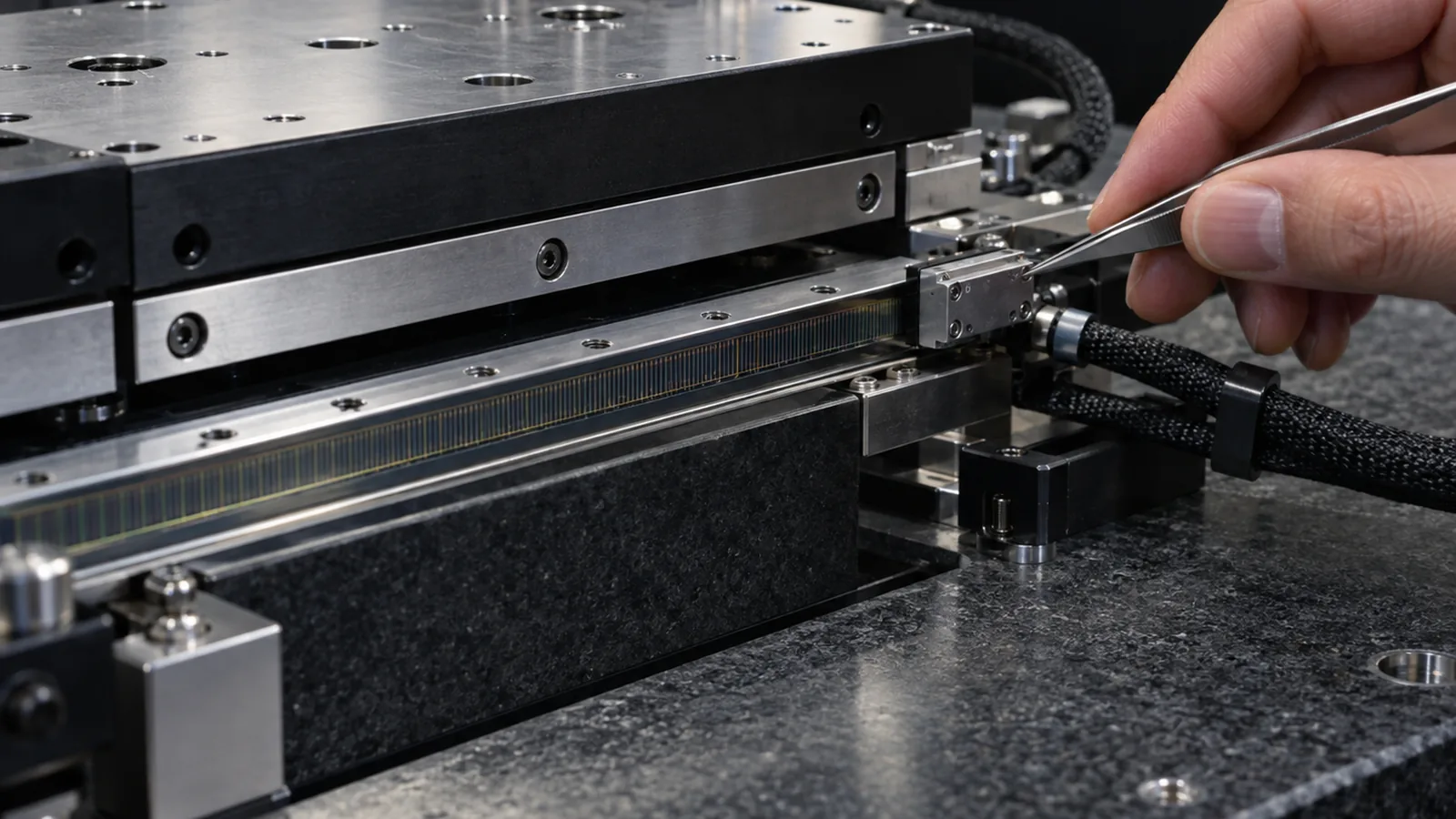
The architectural difference is small to state and large in consequence. An incremental encoder produces a stream of signal cycles as the scale moves past the readhead. The controller counts those cycles and knows the change in position, not the position itself. A datum is established by moving to a limit switch, a reference mark or an index pulse, and that datum survives only as long as the controller keeps counting correctly with power applied. An absolute encoder reads a code track whose pattern is unique along the scale, so the readhead can report its position within one scale segment or one revolution immediately, and the controller translates that code into a machine coordinate.
The consequence is not that one device is more accurate. Accuracy comes from the scale, the interpolation, the mounting and the machine mechanics, and both architectures share every one of those terms. The consequence is availability: whether the axis can be told where it is without moving. Every place in a machine where a move to establish position is undesirable or unsafe is a place where absolute feedback changes the design: a vertical axis that must not drop, a stage inside a vacuum chamber with no access for a homing move, a gantry that would need synchronisation before motion, a spindle with a workpiece engaged, or a tool changer whose magazine position must be known before the first move.
It is equally important to be precise about what absolute feedback does not remove. It does not remove the need for a defined startup validation. The controller must still check that the reported position is plausible, that no alarm or error flag is set, that the configuration matches the scale actually fitted, and that the machine coordinate offset is intact. A machine that trusts an absolute position blindly is less safe than one that homes carefully, because a wiring or configuration fault can present a confident wrong answer that no homing move would have caught.
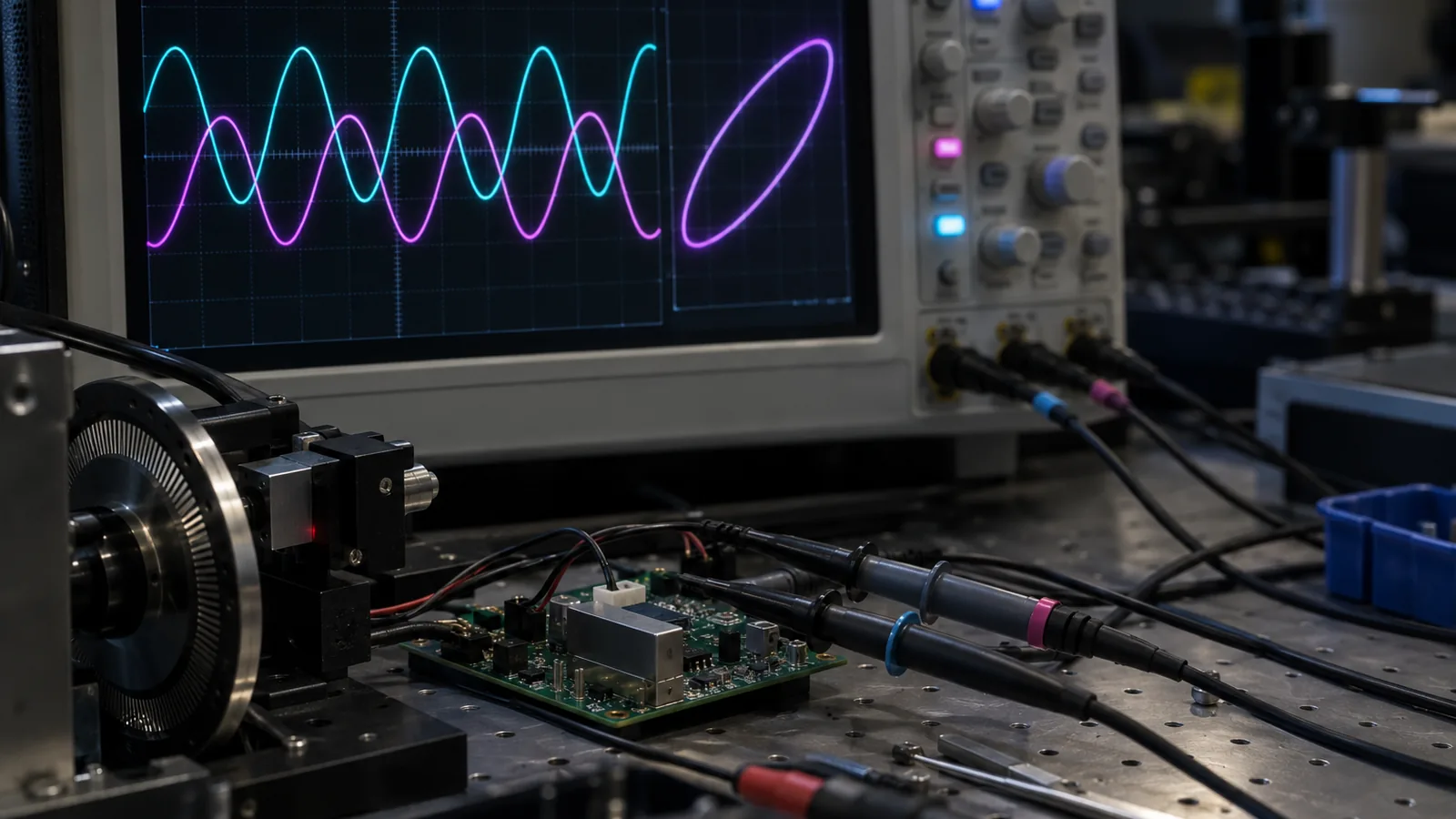
The interface is where the two architectures diverge most in integration effort. Incremental feedback is defined electrically and understood everywhere: differential A/B/Z quadrature, or analogue sine and cosine that the controller or the readhead interpolates. Signal frequency rises with speed and falls with scale pitch, so the practical limits are the output bandwidth, cable quality and the controller input rate. Commissioning mostly consists of confirming count direction, placing the index or reference mark sensibly, and checking noise immunity.
Absolute feedback adds a protocol. BiSS-C, for example, is a synchronous serial interface in which the controller supplies the clock and the encoder returns a frame containing position, status and error information. That brings real advantages: diagnostics, a defined validity flag and a single digital path that is less sensitive to analogue amplitude degradation. It also brings a timing budget. Clock frequency, frame length, cable length and propagation delay together determine how quickly a new position arrives, and on a fast axis with a short control-loop period that budget has to be calculated rather than assumed.
For both architectures the mechanical side is unchanged and still dominates the result: readhead gap, scale flatness, alignment tolerances, cable routing and shielding, connector quality and grounding. Most field problems attributed to the encoder architecture are actually installation or cabling problems. When a comparison is being made, hold the mechanical design constant and compare only the feedback path, otherwise the exercise measures the installation rather than the architecture.
A per-unit price comparison is the least useful way to compare these architectures. An absolute encoder costs more at purchase and usually less at commissioning and recovery; an incremental encoder costs less at purchase and then pays a small amount many times over. The recurring cost has three parts: the elapsed time of each homing move, the number of homing events per day, and the consequence when a homing move is not possible or goes wrong.
Worked honestly, the numbers often decide the question by themselves. A stage that homes in fifteen seconds and recovers four times per shift across two hundred working days loses roughly three hours per year per axis, which alone may not justify the difference. The same stage inside a process where an interrupted home means a scratched substrate, a re-qualified recipe or a manual intervention under a guard interlock has entirely different arithmetic, and the absolute option becomes cheap. Add the hardware an incremental axis needs anyway — limit switches, a reference mark or index detection, wiring back to the cabinet, and the logic to handle a partial or failed home — and the gap narrows further.
There is also an availability argument that appears late in a machine's life. Incremental homing depends on mechanical repeatability: the switch or index must be found in the same place, every time, for years. Wear, contamination, thermal growth and a loosened bracket all move that datum slowly, and the symptom is a position offset that appears after a recovery rather than during production, which makes it easy to misdiagnose. Absolute feedback moves the failure mode out of mechanics and into electronics and diagnostics, which are usually easier to detect, log and trend.
A per-axis selection workflow for machine builders
Start from the machine sequence rather than the catalogue. Write down what happens at power-up, after an emergency stop, after a servo fault and at the start of each shift, then mark every step that currently requires a move to establish position. Those steps are the candidate value of absolute feedback, and their total time per day is the number to argue with. Next, check the controller: if it already supports the absolute protocol natively and the cable run is short, most of the integration effort disappears; if it needs a new interface card, a firmware change and a new commissioning procedure, the honest cost rises accordingly.
Then quantify the recovery cost. Measure the actual homing time on the real machine rather than the bench, count the events per day from the machine log rather than from memory, and attach a cost to a failed or interrupted home. Compare that against the per-axis price difference plus interface work. Finally, hold a reserve for the axes where neither the cost nor the recovery argument is decisive: those are usually best decided by standardisation, because one feedback type across a machine family simplifies spares, training, diagnostics and commissioning documentation.
SENFU supplies both architectures and the review is deliberately neutral. Send the axis list with travel, speed, controller, cable length and startup sequence, and the response is a per-axis recommendation with the reason attached, rather than a push toward one product line. Where an axis genuinely benefits from position retention, the recommendation names an absolute BiSS-C configuration such as SAG21; where the machine already homes reliably and the signal path is simple, an incremental configuration such as SMG20 or SMG26 usually remains the better value over the service life of the machine.
Checklist: what to send for a per-axis recommendation
A useful architecture review needs only a small set of facts for each axis:
Travel length, scale mounting direction and available readhead envelope
Maximum velocity and acceleration, with the resulting control-loop period
Controller or drive model and the feedback inputs it already supports
Cable length, routing, connector type and any EMC constraints
Absolute and incremental encoders measure the same quantity with comparable accuracy; what differs is whether the axis knows its position without moving, and what that knowledge costs in interface work, commissioning effort and per-event recovery time. Machines with long travel, guarded envelopes, vertical axes or expensive interruptions favour absolute feedback. Machines that home quickly and safely, and whose controllers already count quadrature cleanly, are usually better served by incremental feedback at lower cost.
To work through the choice on a real machine, send the axis list with travel, speed, controller model, cable length and the startup sequence. SENFU application engineering returns a per-axis recommendation with the arithmetic shown, the interface and timing evidence for the proposed configuration, and the commissioning checks that make either architecture verifiable on the machine rather than assumed.
Startup and recovery sequence per axis, with the elapsed time of each homing event
Controller feedback inputs supported, including BiSS-C mode, timing and error handling
Cable length, clock rate and frame timing budget for the proposed absolute interface
Homing repeatability data measured on the real machine over the service interval
Commissioning baseline: position validation, alarm behaviour and recovery test record
FAQ
Questions engineers ask before selection.
Is an absolute encoder more accurate than an incremental encoder?
Not inherently. Accuracy comes from the scale, interpolation, mounting, alignment and machine mechanics, which both architectures share. The difference is availability of position at power-up, not measurement quality. Compare accuracy by comparing scale accuracy and system error budget for the specific configuration, not by comparing architecture names.
Does an absolute encoder remove the homing routine completely?
It can remove the routine homing move, but it does not remove startup validation. The controller must still confirm that the reported position is plausible, that no error or alarm flag is set, that the configuration matches the fitted scale, and that the machine coordinate offset is intact before motion is enabled. Many machines keep a periodic reference check as a cross-check rather than as a datum search.
When is an incremental encoder the better choice?
When the machine already has a fast, safe and repeatable homing routine, the controller natively supports quadrature or analogue sine/cosine inputs, cable runs are simple, and the axis recovers rarely. It is also the better value when the lowest cost per axis matters more than startup recovery, or when very high update rates and low latency are needed on a fast axis.
What does absolute feedback cost beyond the encoder itself?
A supported digital interface on the controller or drive, a cable and clocking budget with verified maximum length, connector and EMC design, and a commissioning step that validates the reported position and alarm behaviour. Where the controller needs a new interface card or firmware work, that integration cost belongs in the comparison.
How do I estimate whether homing time justifies absolute feedback?
Measure the real homing time on the machine, count homing events per day from the machine log, and multiply by the working days per year. Add the cost of a failed or interrupted home, including scrap, re-qualification and operator time. Compare that annual figure with the per-axis price difference plus interface work, and the decision usually becomes straightforward.
Can a machine mix absolute and incremental axes?
Yes, and it is common. Axes that would otherwise need a long or risky homing move receive absolute feedback while simple, fast-homing axes stay incremental. The practical requirement is that the controller supports both input types and that commissioning documentation states clearly which axes require validation and which require a homing move.