
Resolution at the real gap
State the achievable linewidth for proximity printing at the gap the substrates demand, and compare it with the maskless optical resolution and pixel pitch.
TECHNOLOGY / PATTERNING ROUTES
Contact and proximity printing through a photomask still dominates many laboratories, while maskless direct write removes the mask entirely. This guide compares resolution, overlay, cycle time, cost behaviour and flexibility across the three routes for research and pilot-line patterning.
Published
DIRECT ANSWER
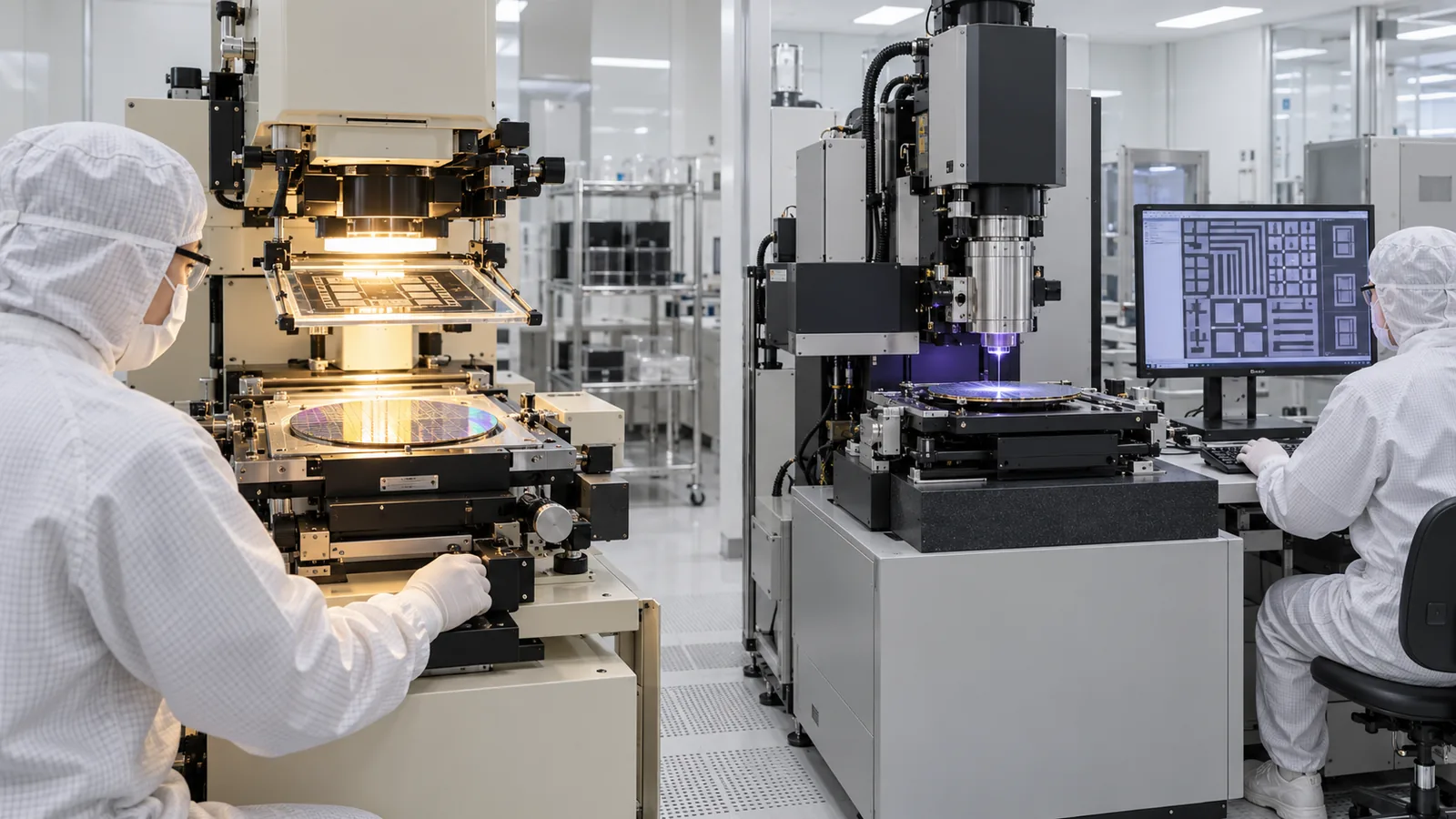
Contact and proximity printing replicate a photomask in one exposure flash: they are fast per wafer, cheap per wafer and resolution-limited by gap and diffraction, typically a few micrometres in proximity mode with mask wear as the standing risk of contact mode. Maskless lithography writes the pattern directly from digital data through a programmable pattern engine: resolution follows the optics and pixel pitch, layout changes cost nothing but a file, and every wafer receives a fresh, undamaged pattern.
The decision is a workload question, not a quality ranking. If a design is frozen, masks are amortised over many substrates and the geometry survives proximity-gap limits, a mask aligner remains the lowest-cost route. If layouts change weekly, substrate types vary, or the team pays repeatedly for mask revisions and dead stock, direct write removes the mask from the critical path and usually wins on total cycle time even though each exposure takes longer than a flash.
ENGINEERING CONTEXT
Laboratories inherit their patterning habits. A mask aligner bought years ago defines the workflow, and the hidden costs of mask-based work, lead time, revision cycles, storage, wear and the quiet reluctance of researchers to iterate a design because a new mask costs money and weeks, never appear in any capital justification. Neither framing produces a good decision. The honest comparison holds the actual workload constant, counts mask costs and waiting time as real costs, and asks which route delivers the pattern on the substrate with the required fidelity and overlay at the lowest total cycle time. That comparison changes its answer with batch size, which is why it needs to be done explicitly rather than by habit.
Discuss your requirement ↗CRITICAL REQUIREMENTS
State the achievable linewidth for proximity printing at the gap the substrates demand, and compare it with the maskless optical resolution and pixel pitch.
Define multi-layer overlay targets and compare mask-to-substrate alignment with the data-driven alignment of a direct-write system.
Compare per-wafer exposure time against the full loop of mask ordering, revision, shipping and storage for evolving designs.
Cover size range, thickness, topography, resist and wavelength compatibility for both routes before committing a workflow.
BUYER MATRIX
Give every shortlisted supplier the same process definition and request configuration-specific proof.
| Decision factor | Contact printing | Proximity printing | Maskless direct write |
|---|---|---|---|
| Resolution limit | Best of the three; limited by optics, resist and mask-substrate conformity | Gap-dependent; diffraction degrades linewidth as gap grows | Set by wavelength, optics and pixel pitch; independent of gap |
| Mask dependency | Physical mask required for every layer | Physical mask required; gap control added | None; pattern defined by digital data |
| Layout iteration | New mask per revision: cost and lead time every cycle | Same mask burden as contact | File change only; no physical tooling |
| Mask wear and defects | Direct mask-substrate contact causes wear and contamination transfer | Wear greatly reduced, diffraction penalty applies | No wear; identical pattern every exposure |
| Per-substrate throughput | Very high; single exposure flash per layer | High; comparable to contact | Lower; writing time scales with area and pixel count |
| Overlay mechanism | Mechanical mask alignment with microscope | Mechanical alignment plus gap stability | Data-driven alignment to substrate marks with autofocus |
Mask-based printing and direct write solve the same problem with opposite contracts. A mask aligner replicates a finished physical artefact: the pattern quality is decided when the mask is made, and every substrate thereafter receives that fixed geometry in one flash. Maskless lithography generates the pattern optically during exposure from digital data, so the pattern quality is decided by the optics, the pixel pitch and the dose strategy at write time, and can be different on every substrate if the workflow requires it.
Neither contract is superior in the abstract. Replication is unbeatable when the geometry is stable and the batch is large: one mask, thousands of identical exposures, negligible marginal cost. Generation is unbeatable when the geometry is unstable or the batches are small, because there is no tooling to amortise and no reason to freeze a design before it is proven.
In hard contact, the mask touches the resist-coated substrate and the replica fidelity is excellent for features down to around a micrometre with suitable optics and resist. The price is paid in the mask: repeated contact wears the chrome, embeds particles and transfers contamination, and each defect then prints on every following substrate until the mask is cleaned or replaced.
Proximity printing trades that problem away by holding a gap, typically a few to a few tens of micrometres, which extends mask life and suits fragile or already-processed substrates. Diffraction now broadens the image, and the achievable linewidth degrades roughly with the square root of the product of gap and wavelength, so a geometry that prints cleanly at near contact may fail at the gap that bent or topographed substrates demand. The honest specification is therefore gap-specific: state the gap your substrates force, and judge resolution there, not in the best case.
A maskless system projects a programmable pattern engine through reduction optics onto a substrate mounted on precision stages, writing the layout tile by tile or flash by flash. Resolution follows wavelength, optics and pixel pitch, and modern DMD-based tools hold single-micrometre critical dimensions with autofocus maintaining focus over warped or topographed substrates. Because the pattern exists as data, alignment to existing features is data-driven: the tool reads substrate marks and places layers to the measured overlay, removing operator-to-operator variation from the loop.
The structural advantages follow from the data. Revision cycles collapse from weeks to minutes and every wafer receives a defect-free, unworn pattern. The structural cost is throughput: writing time scales with area and pixel count, so large areas at fine pixel pitch take minutes rather than the flash of a mask exposure. For prototype and pilot work this trade almost always favours direct write in total cycle time, but a workload of large, frozen patterns is exactly where replication keeps its crown.
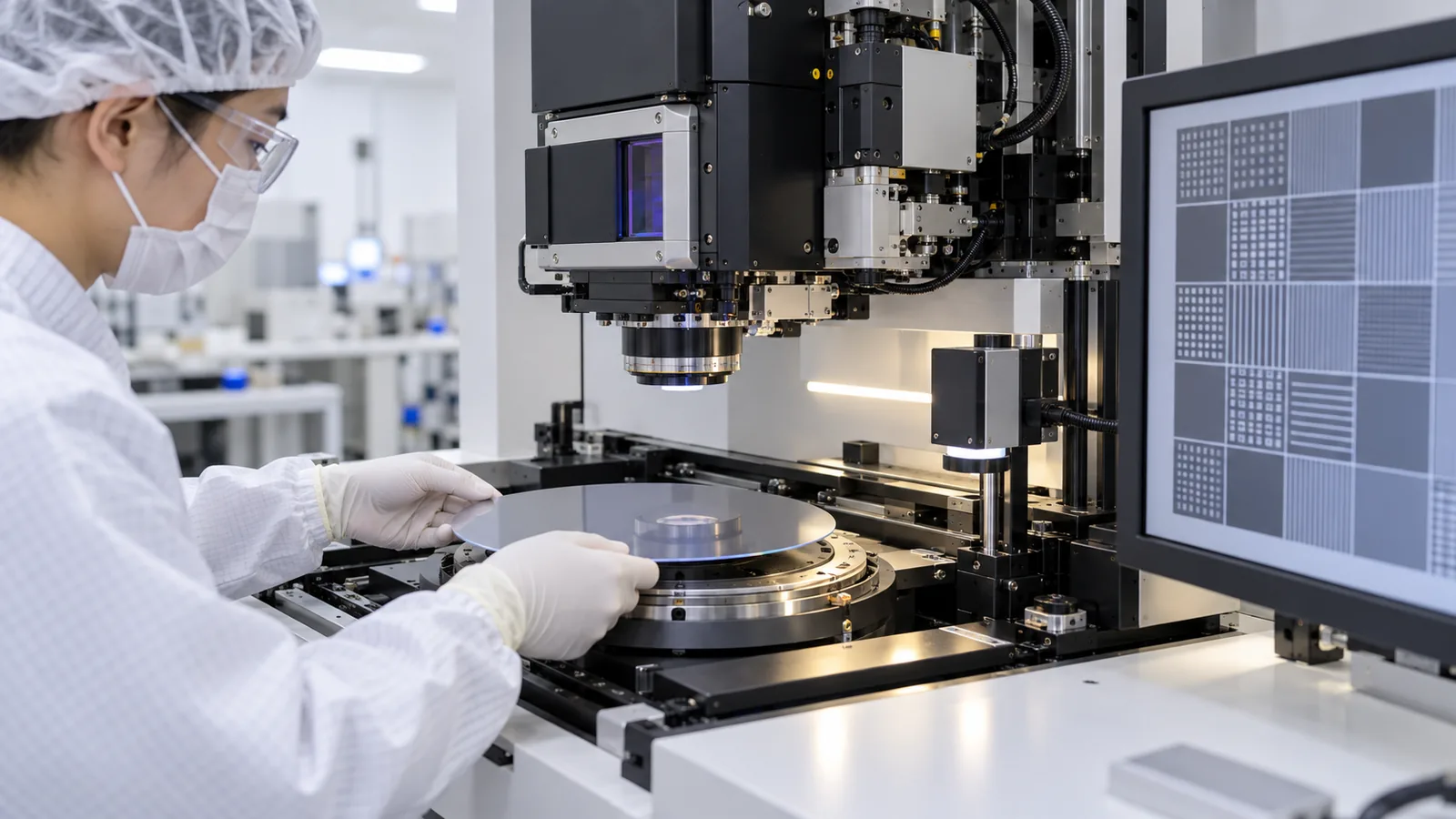
The mask is where naive comparisons fail. A per-wafer flash time of seconds looks decisive until the calculation includes the mask order that preceded it: days to weeks of lead time, procurement overhead, revision rounds as the design converges, shipping and storage. In an iterating R&D environment the mask is usually the critical path, and the aligner stands idle more often than it flashes. Direct write inverts the accounting: exposure is slower per substrate, but there is nothing to order, so the first good pattern typically lands on a substrate days earlier despite the longer write.
Batch size is the crossover variable. Below the mask-amortisation point, which moves with every revision cycle, direct write wins on cost and calendar; above it, replication wins per wafer and the mask cost dissolves into the batch. Teams should plot their own workload honestly, including how often designs actually change, and place each pattern level on the route that serves it. Hybrid workflows are common and legitimate: iteration and critical small features direct-written, stable large-area levels replicated.
Run the comparison on real data rather than datasheet superlatives. Take the last six months of patterning jobs and classify them by batch size, revision count, substrate type and feature size. Compute the mask-inclusive cycle time for the mask route and the write time for the direct route at your required dose and pixel settings. Add the overlay requirement for multi-layer work and the substrate envelope for warped, thick or unusual samples, which often decides the question before resolution does.
CONCLUSION
Contact and proximity printing replicate fixed geometry at very low marginal cost; maskless direct write generates geometry from data at the price of longer exposure per substrate. The right route follows the workload: stable designs in large batches favour the mask, iterating designs, small batches and mixed substrates favour the file. Count mask lead time and revisions in every comparison, judge resolution at the gaps and settings your substrates actually impose, and verify the winner with exposures on your own process before committing the workflow.
SOLUTION ROUTES
EVIDENCE CHECKLIST
FAQ
It depends strongly on the gap. Near contact, features around one to two micrometres are achievable with good optics and resist; at tens of micrometres of gap, diffraction typically pushes practical linewidths into the several-micrometre range. Always state resolution together with the gap at which it was measured.
Modern DMD-based direct-write tools achieve single-micrometre critical dimensions, which overlaps much of contact printing's practical envelope.
When the geometry is frozen, the batch is large enough to amortise the mask, and the feature sizes fit the usable gap. Then replication delivers the lowest cost and highest throughput per substrate, and no digital route changes that economics.
The direct-write system aligns to marks on the substrate using its imaging system and stages, and places each layer from measured positions. This removes mechanical mask-alignment variation and typically improves operator-to-operator consistency, though the achievable overlay still depends on stage accuracy and mark quality.
Yes, and most mature facilities end up with a hybrid: maskless direct write for prototypes, iteration and small batches, and mask-based replication for stable high-volume levels. Assigning each pattern level to the route that serves it beats forcing one workflow on everything.
AUTHORITATIVE SOURCES
TECHNICAL REVIEW
Send the application, critical parameters and any drawing or process information available.
Discuss your application ↗