
Stated failure definition
The reliability calculation must define what constitutes a failure of the encoder feedback path, including degradation thresholds and whether preventive-maintenance events are excluded.
TECHNOLOGY / RELIABILITY ENGINEERING
MTBF and MTTR figures appear in every capital-equipment proposal, but they are only useful if you can ask how they were derived, what failure definition they use, and what evidence supports them. This guide explains how to specify, question and verify reliability numbers for optical encoders and lithography systems during procurement.
Published
DIRECT ANSWER
MTBF (mean time between failures) predicts the average operating time between failures of a repairable system, while MTTR (mean time to repair) predicts the average downtime to restore it after a failure; their sum bounds availability as MTBF/(MTBF+MTTR). For optical encoders and lithography systems, a stated MTBF is only meaningful when the failure definition, the operating and environmental assumptions, and the data source—field population hours, accelerated life testing, or a standards-predicted part count—are stated alongside it. The same numeric MTBF can be honest under one definition and misleading under another.
Verification in procurement therefore rests on three questions: where did the number come from (field data with defined population and hours beats prediction standards beats manufacturer optimism), what counts as a failure (functional failure of the complete feedback path versus component-level or degradation-only events), and what evidence will be delivered (failure logs, service records, spare-parts strategy, and diagnostics that turn degradation into planned maintenance rather than downtime). MTTR verification is equally concrete: documented swap procedures, pre-aligned replacement units, available spares and defined support response convert a claimed MTTR into a schedule a production planner can actually use.
ENGINEERING CONTEXT
Reliability numbers in proposals are easy to state and hard to compare. One supplier's 100,000-hour encoder MTBF may be derived from a parts-count prediction standard; another's 60,000 hours may come from a real field population with documented failures—making the second number the stronger evidence despite being smaller. Failure definitions differ: a degraded signal that still counts, a dirty scale wiped during preventive maintenance, an LED that drifted past its alarm threshold—each may or may not enter the statistic. MTTR claims often ignore the parts that dominate real downtime: diagnosis time, spare availability, realignment after replacement. Buyers who compare MTBF figures at face value select on the least informative number on the page; buyers who verify definitions, data sources and recovery logistics get reliability that shows up in uptime.
Discuss your requirement ↗CRITICAL REQUIREMENTS
The reliability calculation must define what constitutes a failure of the encoder feedback path, including degradation thresholds and whether preventive-maintenance events are excluded.
Field population size and hours, mission profile, temperature and vibration assumptions, or the prediction standard used, must accompany any MTBF figure.
Mean time to repair must be broken into diagnosis, spare logistics, replacement and realignment, with each component evidenced by procedure documents.
Built-in signal-quality monitoring and alarms convert incipient failures into planned maintenance, which is what actually protects uptime between failures.
BUYER MATRIX
Give every shortlisted supplier the same process definition and request configuration-specific proof.
| Source | What it is | Strength | Watch for |
|---|---|---|---|
| Field data (own population) | Failures and operating hours from installed units in defined service | Strongest evidence—real failure modes, real environments | Check population size, censoring and failure definition |
| Accelerated life testing | Elevated stress testing extrapolated to use conditions | Good for dominant wear-out mechanisms | Extrapolation model and stress levels must be justified |
| Prediction standards (part-count) | Calculated MTBF from component failure-rate handbooks | Comparable and cheap; fine for early estimates | Optimistic for electromechanical and contamination-driven failures |
| Datasheet figure without basis | A number with no stated derivation | None for verification purposes | Treat as marketing until a source is supplied |
MTBF is a mean of intervals between failures for a repairable system, measured in operating hours. MTTR is the mean elapsed time from failure to restored operation. Availability—the fraction of scheduled time the machine can produce—is bounded by MTBF/(MTBF+MTTR), which is why the two numbers belong together in a specification: a large MTBF with an uncontrolled MTTR still produces unacceptable downtime, and a fast MTTR cannot save a tool that fails weekly. For encoder systems, the repairable unit in question should be defined precisely: the readhead, the scale, the interface electronics, and the interconnect have different failure rates and different repair paths.
The most common procurement error is treating MTBF as a warranty period or an expected life. An encoder with a 100,000-hour MTBF is not guaranteed 100,000 hours; it is a statistic about the failure rate of a population. For component wear-out mechanisms—LED illuminator degradation, cable flex fatigue, bearing wear—the more relevant engineering quantities are service life under defined conditions and the condition-monitoring that warns before the wear-out completes.
When a reliability figure appears in a proposal, the verification conversation has three moves. First, the definition: does the failure count include only hard functional failures of the complete feedback path, or also soft events—signal degradation, alarm resets, contamination cleaning? Are scheduled preventive maintenance actions excluded? Second, the source: field data should come with population size and accumulated hours, because a number from 200 units over three years is evidence while one from 12 units over four months is an anecdote. Prediction-standard figures should name the standard and its limitations. Third, the assumptions: temperature, vibration, duty cycle and cleanliness. An encoder MTBF quoted for a benign laboratory environment does not transfer to a vacuum interface or a vibrating grinding machine.
These questions are not adversarial; serious manufacturers answer them routinely, and a supplier who cannot produce the derivation is telling you the number is not load-bearing in their own quality system. The answer set belongs in the qualification record next to the factory audit and the incoming acceptance test.
MTTR verification is procedural, not statistical. Break the claimed mean time to repair into its real components: detection and diagnosis (does the system's alarm logic localize the failure to a replaceable unit, or does the service engineer?), logistics (is a spare on site, within the region, or on a factory lead time?), replacement (is the procedure documented—air gap, alignment, torque, reference mark re-datum?), and verification (what test proves the replacement restored accuracy?). Each component has paper evidence: alarm documentation, spare-parts commitments with lead times, exchange procedures, and acceptance-test criteria for post-repair verification.
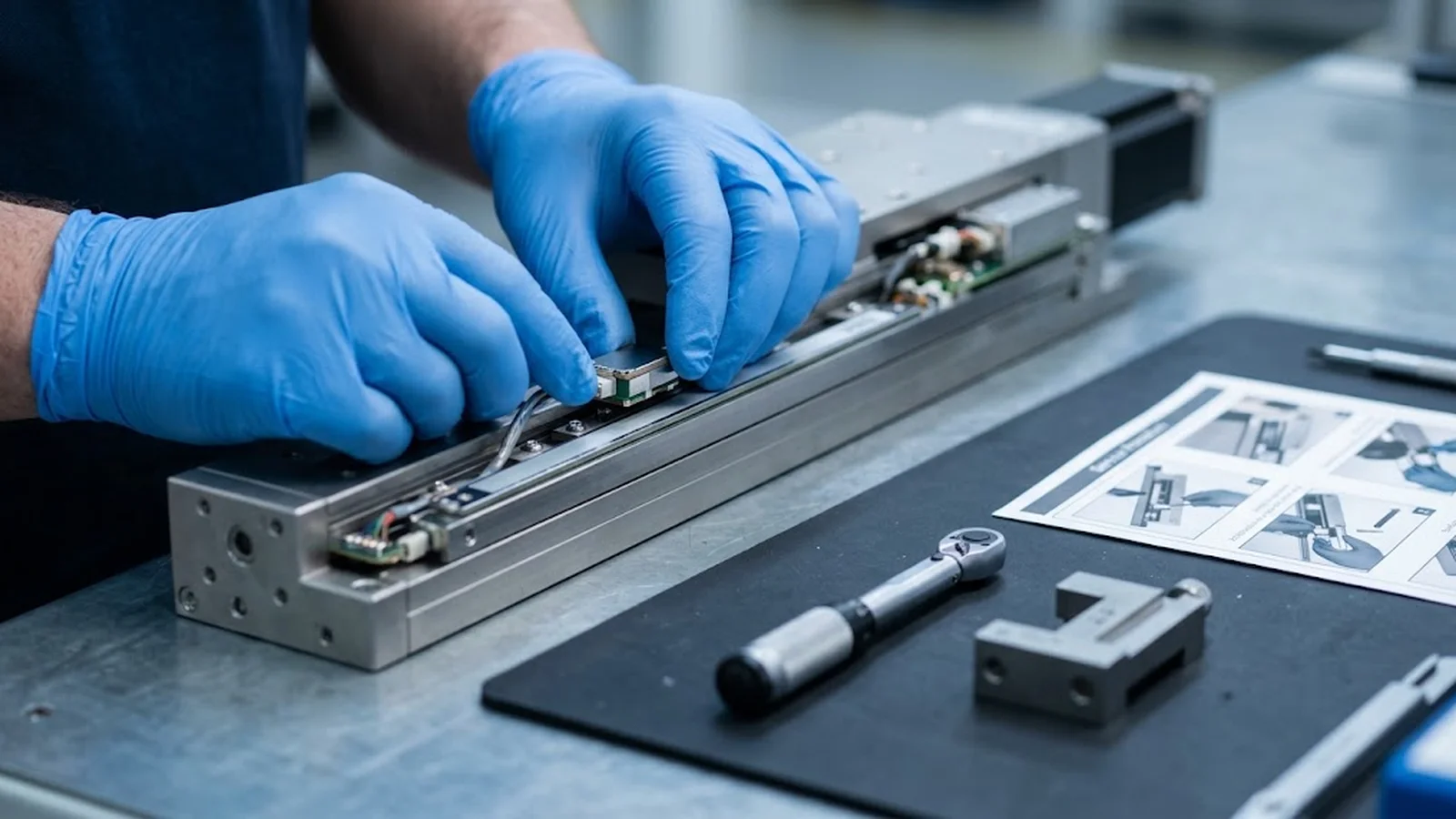
Design features shorten the arithmetic directly. Pre-aligned replacement readheads, scales with reference marks that restore the datum without re-mastering, plug-and-play interface connections, and built-in signal-quality diagnostics that identify the failing element all cut hours from the repair path. This is also where reliability engineering meets serviceability: a readhead that takes 40 minutes to swap with alignment tooling and 4 hours without it has two MTTRs, and the specification should say which one is being promised.
Between failures, the quantity that protects uptime is early warning. Optical encoders that expose signal-quality telemetry—signal amplitude, quadrature balance, interpolation margin, contamination indicators—let the controller trend degradation and schedule intervention during planned maintenance windows. In availability terms, diagnostics shift events from the unplanned failure column (full MTTR) to the planned column (a fraction of the downtime, scheduled at convenient hours). For production tools this often matters more than a marginal MTBF difference: a machine that warns two weeks before a readhead fails is operationally superior to a machine that fails without warning, whatever the datasheets say.
Procurement should therefore weight the diagnostic and monitoring capability alongside the reliability statistics: what parameters are exposed, what thresholds trigger alarms, and whether the machine's maintenance plan includes reviewing them. The reliability story that survives contact with production is built from all three: a defensible MTBF, a short verified MTTR, and diagnostics that convert surprise into schedule.
The requirements section of an RFQ is where verification begins. Rather than requesting a bare MTBF number, request: the reliability figure with its derivation and assumptions; the failure definition; the MTTR broken into diagnosis, logistics, replacement and verification with supporting procedures; the spare-parts strategy and lead times; and the diagnostic telemetry with recommended maintenance review intervals. Ask for field references—an installed base in a comparable application—that can be contacted. Suppliers who engineer for reliability welcome the specificity, because it prices their engineering honestly against suppliers whose figures are marketing copy.
Finally, connect the reliability requirements to the acceptance path: incoming acceptance testing, installation qualification and periodic signal-quality checks during operation are the mechanisms by which the promised statistics stay true in your facility. Reliability is not delivered in the datasheet; it is maintained by the procedures that surround the hardware for its whole service life.
CONCLUSION
MTBF and MTTR are useful procurement instruments only when their definitions, data sources and assumptions travel with them. Field population evidence beats prediction standards; a stated failure definition beats a bare number; and a repair path broken into diagnosis, logistics, replacement and verification beats an abstract mean time to repair.
The buyer's leverage lies in the questions: what counts as a failure, where did the hours come from, and what paperwork proves the recovery path. Suppliers who answer fluently are the ones whose reliability numbers will still mean something after installation—and whose diagnostics will convert the remaining surprises into planned maintenance.
SOLUTION ROUTES
EVIDENCE CHECKLIST
FAQ
Field figures for optical encoder feedback systems commonly run in the tens of thousands to hundreds of thousands of operating hours depending on environment, duty cycle and how degradation events are counted. The realistic figure for your application is the one derived from a comparable population and stated assumptions—duty cycle, temperature, vibration, contamination—rather than a generic datasheet number.
No. MTBF is a failure-interval statistic for a repairable population; service life is the duration until wear-out mechanisms—LED degradation, cable flex fatigue, mechanical wear—end useful operation even with maintenance. A component can have a long MTBF and a shorter defined service life, and both belong in the specification.
Request it decomposed: diagnosis time supported by alarm documentation, spare-parts logistics with lead times and stocking commitments, replacement time supported by the documented procedure, and verification time supported by the post-repair acceptance test. A single aggregate MTTR number without this breakdown cannot be verified or compared.
Yes, for early design comparisons and consistency across proposals, since they apply the same calculation basis to different systems. But they tend to be optimistic for contamination-driven and electromechanical failure modes, so they should be treated as a baseline to be superseded by field data as the installed base grows.
Diagnostics shift failures from unplanned to planned. Trending signal amplitude, quadrature balance and interpolation margin flags degradation weeks before functional failure, allowing replacement in scheduled windows at a fraction of the full MTTR downtime. In production environments this often improves availability more than a marginal MTBF increase.
AUTHORITATIVE SOURCES
TECHNICAL REVIEW
Send the application, critical parameters and any drawing or process information available.
Discuss your application ↗