
Duty cycle calculation
Cycles per hour multiplied by service years, expressed as a required cycle count the cable must exceed with margin.
TECHNOLOGY / ENCODER CABLING
Encoder cables on moving axes fail mechanically long before the encoder does. This guide explains flex life, bend radius, drag chain selection and installation practice for optical encoder cables, and shows how to specify cable evidence that matches the axis duty cycle.
Published
DIRECT ANSWER
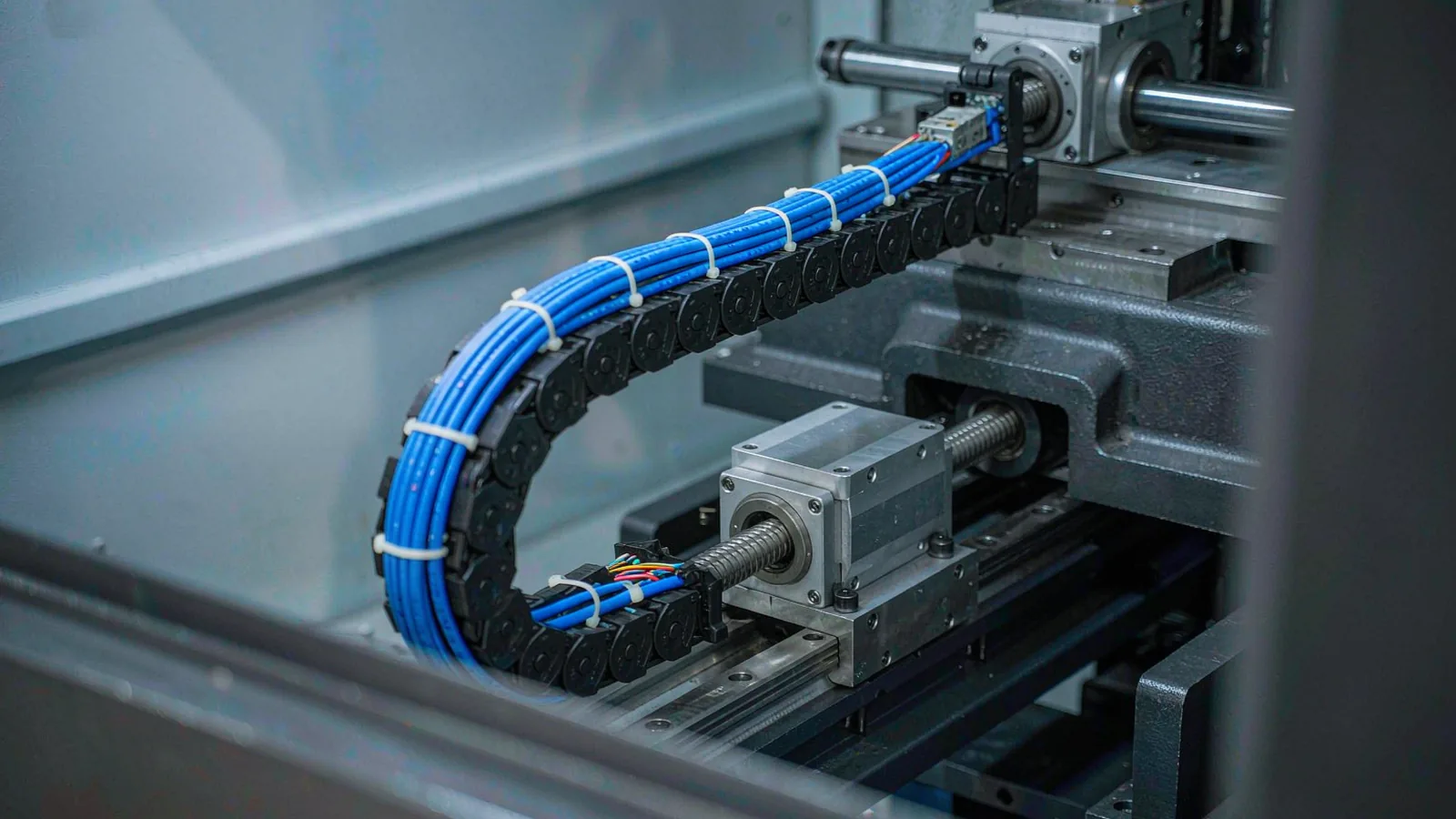
On a moving axis, the encoder cable is the most fatigue-loaded part of the feedback system, and its mechanical life is a design number, not an accident. Flex life is decided by four factors: bend radius, cable construction, jacket material and installation practice. A cable rated for continuous flexing—fine-stranded conductors, short lay lengths, braided shield and a drag-chain-suitable jacket such as polyurethane—reaches many millions of cycles at its stated radius, while a static-rated cable run in a chain can fracture conductors or shields within weeks.
Selection therefore starts from the duty cycle: cycles per hour times service years gives the required cycle count; the chain's inner bending radius and the cable's stated dynamic minimum radius must be compatible; and the installation must keep the cable untwisted, strain-relieved at both ends and free to follow its natural curve inside the chain. Specify the cable and its evidence—cycle count at stated radius and speed—into the machine documentation, because cable failures masquerade as encoder failures and cost far more in diagnostics than the cable ever cost.
ENGINEERING CONTEXT
Encoder cable failures are the classic false-positive of feedback diagnostics. A fractured conductor or a broken shield produces intermittent counts, glitch filter alarms or position jumps that look exactly like an encoder fault, so the replacement cycle starts with the wrong part and ends, weeks later, at the cable. The root cause is usually a specification gap: the axis was designed around encoder accuracy and controller capability, while the cable was chosen from stock by jacket color or availability. Ordinary industrial cables are built for static runs and survive only a few thousand bending cycles; a chain axis making a thousand moves a day consumes that life in days. Even genuine drag-chain cables fail early when installed with twist from the reel, clamped rigidly at both ends, or bent below their dynamic radius at the chain exit. The result is a system whose weakest link was never engineered at all. The fix is to treat the encoder cable as a fatigue part with a stated cycle life, selected and installed to the same evidence standard as the encoder itself.
Discuss your requirement ↗CRITICAL REQUIREMENTS
Cycles per hour multiplied by service years, expressed as a required cycle count the cable must exceed with margin.
Supplier data stating cycle life at a defined bending radius, travel speed and chain geometry—not a generic 'highly flexible' label.
The chain's inner bending radius at or above the cable's dynamic minimum radius, including the vertical radius at chain exits and fixed-end transitions.
Untwisted lay-in, correct diameter clearances inside the chain, strain relief at both ends and a service loop that never enters the flexing section.
BUYER MATRIX
Give every shortlisted supplier the same process definition and request configuration-specific proof.
| Attribute | Static-rated cable | Continuous-flex (drag chain) cable | High-flex robot-grade cable |
|---|---|---|---|
| Conductor construction | Standard stranding, longer lay length | Fine strands, short lay length designed for bending fatigue | Ultra-fine strands with fatigue-optimized stranding |
| Shield type | Spiral or loose braid, optimized for ease of manufacture | Optically monitored tight braid with drain wire, fatigue resistant | Tight braid plus supplementary foil or double braid |
| Typical cycle capability | Hundreds to a few thousand bends before conductor fatigue | Millions of cycles at the stated radius and speed | Tens of millions of cycles at tight radii |
| Jacket materials | PVC common | PUR or drag-chain PVC with abrasion resistance | PUR with high abrasion and torsion capability |
| Suitable encoder duty | Fixed cabinets, static machine runs only | Energy chains on production axes | Robot dress packs, extreme cycle counts, combined bend and torsion |
Flexing fatigue starts in the copper. Every bend work-hardens the conductors, and cracks nucleate where strand movement is greatest, typically at the transition from the chain's moving section to its fixed end. The failure is progressive: first an intermittent open under vibration, then a permanent break. The shield follows the same path, and a fractured shield is particularly misleading because counts still arrive—just with noise-induced glitches that the controller blames on the encoder or the grounding scheme.
The symptom pattern is diagnostic if read correctly. Counts that drop out only during motion, errors that correlate with a specific chain position, alarms that migrate as the cable is flexed during troubleshooting—all point to the cable, not the encoder. A simple continuity test with the cable straight will pass a cable that fails on every chain cycle, which is why the test that matters is continuity while flexed at the working radius. Treating these symptoms as an encoder fault wastes the most expensive component in the loop on the cheapest failure mode.
Every flex-rated cable carries two radii. The static minimum radius applies to fixed runs; the dynamic minimum radius, always larger, applies when the cable bends while in motion, and it is the one that governs chain selection. Exceed it and the neutral-axis strain climbs, moving the outer conductors past their fatigue limit and discounting the cycle life by orders of magnitude. Cycle life ratings are always conditional—stated at a specific radius, travel speed and chain internal geometry—and a cable rated for ten million cycles at its rated radius may deliver a fraction of that at two-thirds of the radius.
The required count comes from the machine's duty cycle, and it is usually larger than intuition suggests. An axis cycling once per minute runs over half a million chain cycles per year, so a five-year service life without cable intervention demands a rating in the tens of millions with margin. Check the vertical radius where the cable exits the chain and at fixed-end transitions, not only the radius inside the chain, because exits are where installed cables most often violate their dynamic limit.
Chain and cable must be chosen together. The cable needs clearance inside the chain chambers—commonly a few tens of percent of diameter depending on the chain series—so it never rubs, kinks or coils; heavy or stiff cables need the largest available chamber and, at diameter transitions, interior separation. Where the supplier offers a pre-configured encoder cable for drag chain use, its construction decisions—strand count, lay direction, shield design, jacket compound—are already matched, and the purchasing task is only to match the radius and cycle rating to the duty cycle.
Cable length inside the chain deserves the same care as outside it. The internal length must allow the cable to follow its natural path at both chain extremes without tension at either end; too short and the cable pulls taut at full stroke, too long and it loops into the moving parts. Note also that a flexing run is a different problem from a torsion run: cables twisted around their own axis, as on rotating dress packs, need torsion-rated construction, and a chain cable is not automatically one.
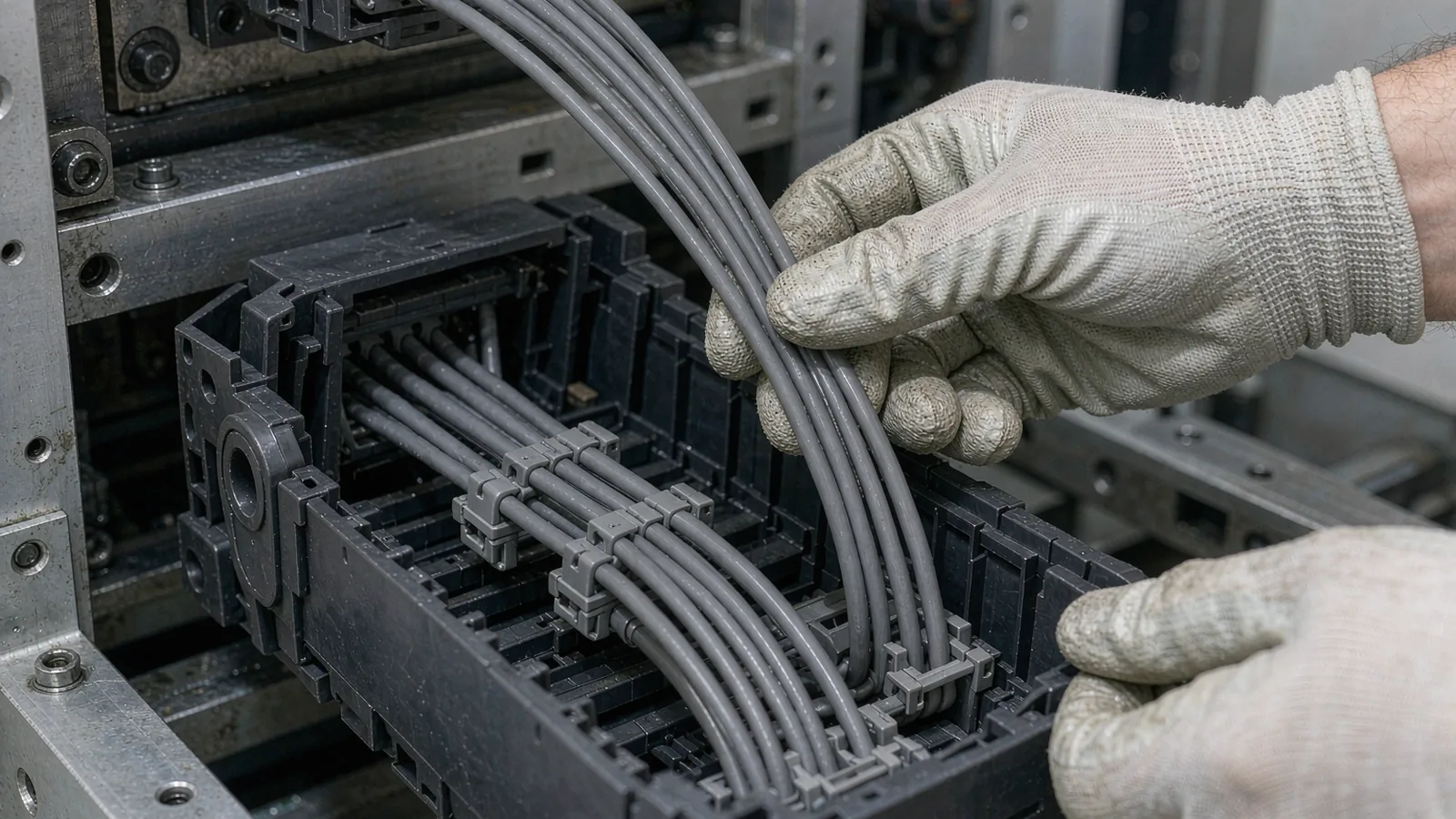
Most premature cable failures are installed, not bought. Cable taken from a reel carries twist that must be relaxed before lay-in; the cable should be paid out straight and allowed to settle, never unrolled under tension into the chain. Strain relief belongs at both ends, clamping the jacket without crushing it, and the transition from chain to fixed run must leave enough service loop that the dynamic radius is respected at the exit. Keep encoder cables separated from power circuits inside the chain where the series allows, and observe the EMC routing rules that the grounding guide covers separately.
Close the installation with evidence: cable type and cycle rating recorded against the calculated duty cycle, radii at chain and exits measured, and a functional run with diagnostics active. Periodic checks then watch for the early signature—a rise in filter rejections or intermittent alarms at particular chain positions—so the cable is replaced on condition during planned maintenance instead of failing mid-production.
SENFU states cable options, jacket constructions and routing limits for its encoders, including configurations suitable for energy chain installation, so the mechanical side of the feedback design can be specified alongside the optical side. When an application is submitted with the travel, cycle rate and chain geometry, SENFU can recommend the cable construction and routing limits that match the duty cycle.
For axes with extreme cycle counts or combined bend-and-torsion motion, SENFU can review the dress-pack concept together with the encoder configuration, so the cable's service life is engineered rather than discovered.
CONCLUSION
On any moving axis, the encoder cable accumulates more stress cycles than every other feedback component combined, and its failure masquerades as an encoder fault until someone pulls the chain. Duty cycle converted into a required cycle count, a continuous-flex cable rated at the chain's real radius, and an installation that lays the cable untwisted and strain-relieved—these three steps convert the most failure-prone link in the feedback loop into a predictable one.
Record the cable type, rating and duty calculation in the machine documentation, and trend the early symptoms so replacement happens on condition. The encoder deserves a cable engineered to the same standard as the rest of the feedback system.
EVIDENCE CHECKLIST
FAQ
Because the cable is the only part of the feedback loop engineered to flex millions of times. Conductors and shields work-harden and crack under repeated bending, producing intermittent counts and noise that mimic encoder faults. A cable chosen from static-rated stock can exhaust its fatigue life within weeks on a chain axis.
The static radius applies where the cable bends once and stays bent; the dynamic radius, always larger, applies where the cable bends while in motion, as inside an energy chain. Flex life ratings are valid only when the dynamic radius is respected, including at chain exits and fixed-end transitions.
Calculate from duty: an axis cycling once per minute exceeds half a million chain cycles per year. For a five-year life without cable intervention the cable should be rated in the tens of millions of cycles at the working radius, with margin added for acceleration profiles and installation imperfections.
No. The rating that matters is cycle life stated at a defined radius, speed and chain geometry. Continuous-flex cables are built differently—fine stranded short-lay conductors, fatigue-resistant braided shields and drag-chain-suitable jackets such as PUR—and their ratings are conditional on the stated installation.
Relaxing the reel twist before lay-in, leaving correct clearance inside the chain chambers, providing strain relief at both ends without crushing the jacket, and respecting the dynamic radius at exits. Most premature failures trace to one of these installed, not bought.
Yes. Submit the travel, cycle rate, chain geometry and environment. SENFU can recommend the encoder cable construction and routing limits for the duty cycle, and review combined bend-and-torsion concepts such as robot dress packs together with the encoder configuration.
AUTHORITATIVE SOURCES
TECHNICAL REVIEW
Send the application, critical parameters and any drawing or process information available.
Discuss your application ↗